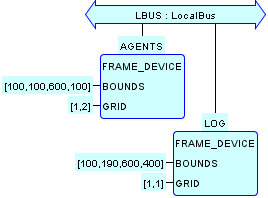
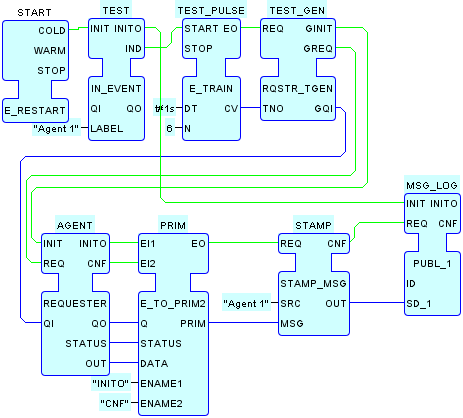
This System Configuration illustrates the use of the Local Multicast design pattern to implement the Time-Stamped Messaging design pattern. As shown at right:
- The
AGENT1resource of theAGENTSdevice contains an instance of theREQUESTERFB type to simulate the operation of a software agent.- An event from an
IN_EVENTbutton triggers the operation of an instance of theE_TRAINtype. - The
E_TRAINoutputs drive an instance of theRQSTR_TGENtype to produce a sequence of test events and data for the simulated agent. - The resulting outputs from the simulated agent are then
converted to service primitive format by an instance of the
E_TO_PRIM2type, time stamped by an instance of theSTAMP_MSGtype, and transmitted for logging via theMSG_LOGlocal multicast channel.
- An event from an
- the
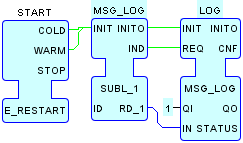
LOG_RESof theLOGdevice receives the generated service primitive reports from theMSG_LOGlocal multicast channel and displays them on an instance of theMSG_LOGHMI FB type.
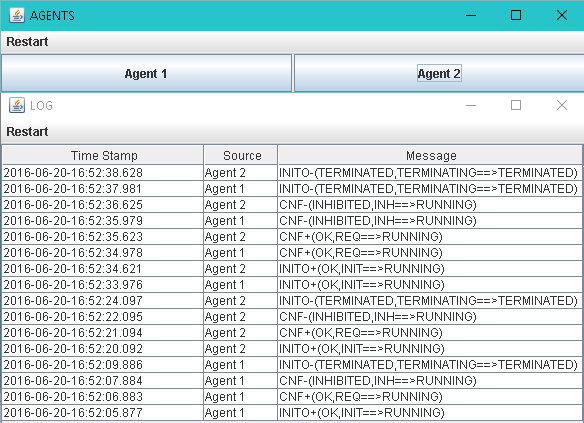
The figure below shows the result of clicking the Agent 1 button; waiting 6 seconds for the sequence of messages to complete; clicking the Agent 2 button and waiting again; then clicking the Agent 1 button immediately followed by the Agent 2 button.